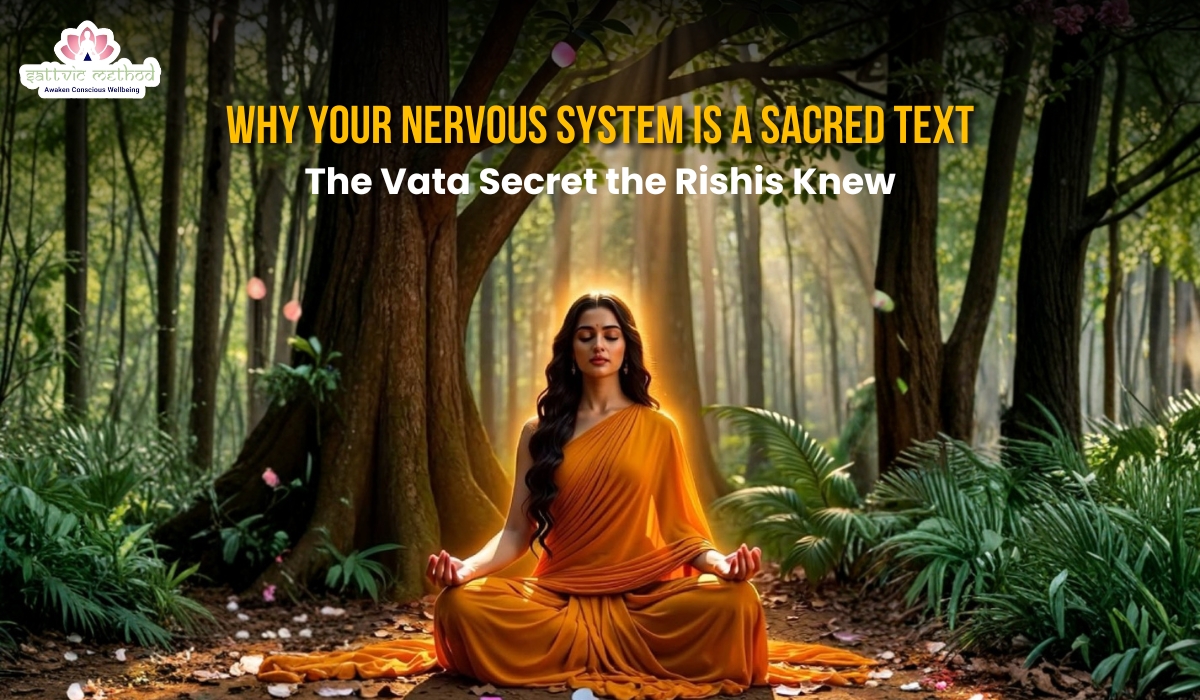
Why Your Nervous System Is a Sacred Text: The Vata Secret the Rishis Knew
What if your nervous system is trying to tell you something?
Have you ever noticed how your mind races even when there is nothing to fear? Your thoughts jump from one concern to another, your sleep becomes lighter, your digestion less predictable, and even moments of silence feel uncomfortable.Modern life often labels this as stress, anxiety, burnout, or overstimulation.
Ayurveda sees something deeper.
More than five thousand years ago, the ancient Rishis described the nervous system not merely as a network of nerves but as the very channel through which life communicates. They taught that when this sacred communication becomes disturbed, every aspect of health begins to lose its natural rhythm.
In Ayurveda, this intelligence is known as Vata Dosha.
Understanding Vata is not simply learning another health concept. It is learning to read one of the most sacred texts you will ever encounter—your own body.
Vata — The Dosha of Your Nervous System
Among the three doshas described in Ayurveda—Vata, Pitta, and Kapha—Vata is considered the master regulator. The ancient physicians recognized that nothing in the body moves without Vata. Every heartbeat, every breath, every thought, every sensation, and every impulse of consciousness depend upon its proper functioning.The classical Ayurvedic text, the Charaka Samhita (Sutrasthana 12.8), describes Vata as the root of all movement within the body and mind.
Vata governs:
-
- Prāna—the life force that animates every cell
-
- Transmission of nerve impulses
-
- Mental clarity and perception
-
- The rhythm of breathing
-
- Sensory awareness
-
- Communication between body and mind
The symptoms are surprisingly familiar:
-
- Constant overthinking
-
- Anxiety without a clear cause
-
- Restless sleep
-
- Digestive irregularity
-
- Feeling overwhelmed
-
- Difficulty focusing
-
- Chronic tension
When Vata becomes disturbed, life begins to feel unpredictable.
The body is no longer responding from peace—it is reacting from survival.
Healing cannot fully begin while the nervous system remains trapped in chronic alertness.
The Rishis understood a truth that modern neuroscience continues to validate:
Regulation always comes before restoration.
You cannot force healing into a body that still believes it is unsafe.
Krishna’s First Teaching Was About the Nervous System
One of the most profound examples of nervous system collapse appears at the very beginning of the Bhagavad Gita.Before Krishna speaks of yoga, devotion, karma, or enlightenment, Arjuna experiences what today might easily be recognized as an acute stress response.
- His body trembles.
- His mouth becomes dry.
- His limbs lose strength.
- His thoughts become confused.
- He cannot act.
- He cannot think clearly.
- He cannot fulfill his purpose.
- Only after acknowledging Arjuna’s inner state does Krishna begin to teach him.
“Let a person elevate themselves by the Self, and not degrade themselves.”
This teaching is far deeper than positive thinking.
Krishna is showing that mastery begins from within.
Before we can make wise decisions, serve others, fulfill our purpose, or deepen our spiritual practice, the mind must first become steady.
The Bhagavad Gita can therefore be viewed as more than a philosophical text.
It is a timeless guide for regulating the inner world.
Its teachings repeatedly return us to breath, awareness, discipline, and inner balance.
Your spiritual practice does not begin only when you sit for meditation.
It begins the moment you stop allowing an unbalanced Vata to direct every thought, emotion, and reaction.
The Breath Body: Where Healing Truly Begins
The Taittiriya Upanishad describes the human being as existing through five interconnected layers known as the Pancha Koshas:-
- Annamaya Kosha – the physical body
-
- Pranamaya Kosha – the energy and breath body
-
- Manomaya Kosha – the mental body
-
- Vijnanamaya Kosha – the wisdom body
-
- Anandamaya Kosha – the bliss body
In modern language, this is remarkably similar to how we understand the nervous system.
Every breath influences the nervous system.
Every nervous system response influences the mind.
When the breath becomes hurried, shallow, or irregular, mental disturbance naturally follows.
The Rishis understood that access to higher wisdom cannot occur while the breath body remains agitated.
One cannot easily experience the deeper dimensions of intuition, insight, or lasting peace when the Pranamaya Kosha is overwhelmed.
Calm the breath.
Steady the nervous system.
Only then does the path toward wisdom and bliss naturally unfold.
The Sacred Invitation
Modern wellness often asks, “How do I fix myself?”Ayurveda asks a more compassionate question:
“What is my nervous system trying to communicate?”
Every racing thought…
Every restless night…
Every anxious breath…
Every moment of overwhelm…
may be an invitation to return to balance rather than push harder.
Your nervous system is not your enemy.
It is your messenger.
The ancient Rishis never separated spirituality from physiology because they understood that consciousness expresses itself through the body.
To care for your nervous system is not merely self-care.
It is a sacred practice.
Reflection
Today, before trying another productivity technique or another self-improvement strategy, pause for one slow breath.Ask yourself:
Is my nervous system asking to be corrected… or simply to be heard?
That single question may become the beginning of profound healing.
Coming Next in The Science of Sacred Living
Why We Cannot Heal in Fight-or-Flight: Understanding the Parasympathetic Wisdom Hidden in AyurvedaDiscover how ancient Ayurvedic teachings anticipated modern neuroscience and why your body can only repair itself when it feels safe.